Hugo Ninou
PhD student in theoretical and computational neuroscience
Ecole normale supérieure | PSL
Département d'études cognitives de l'Ens
About me
I am a PhD student in theoretical and computational neuroscience at ENS Paris. I’m passionate about drawing inspiration from biological learning to design more effective AI systems.
- Computational neuroscience
- Statistical Physics
- Machine learning
PhD student in Computational and Theoretical Neuroscience
Ecole normale supérieure | PSL
ENS Paris diploma, Major in Physics, 2022
Ecole normale supérieure | PSL
Master MVA, Applied Mathematics, Vision, Machine Learning, 2022
Ecole normale supérieure Paris Saclay
Master ICFP, Theoretical Physics, 2021
Ecole normale supérieure | PSL
Featured Publications

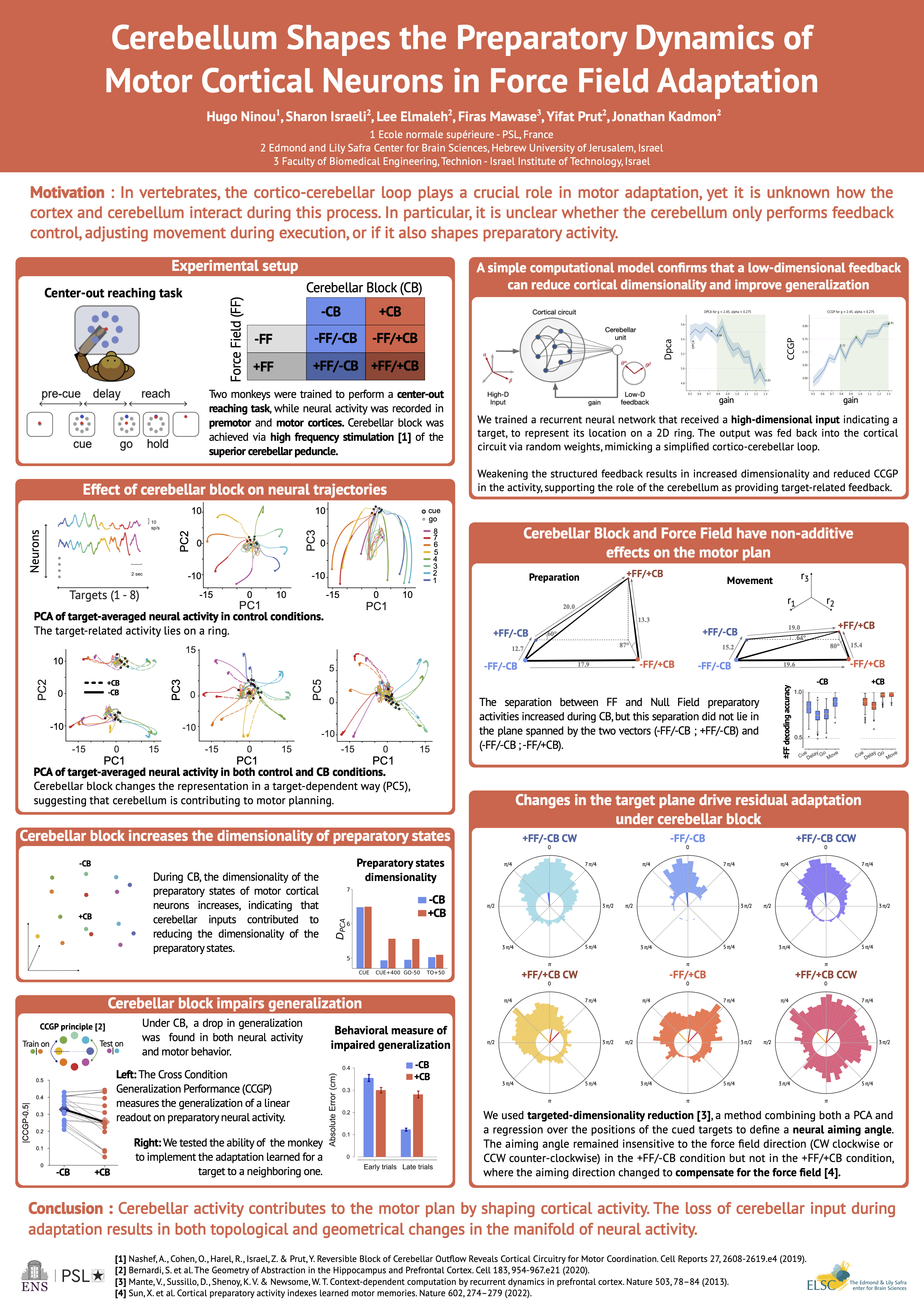
The cerebellum plays a key role in motor adaptation by driving trial-to-trial recalibration of movements based on previous errors. In primates, this adaptive response is achieved by cerebellar modulation of motor cortical signals, but the nature and timing of this process are unknown. Specifically, cortical correlates of adaptation are encoded already in the pre-movement motor plan, but these early cortical signals could be driven by a cerebellar-to-cortical information flow or evolve independently through intracortical mechanisms. To address this question, we trained monkeys to reach against a viscous force field while blocking cerebellar outflow. During the force field trials, the cerebellar block led to impaired adaptation and a compensatory, re-aiming-like shift in motor cortical preparatory activity. In the null-field conditions, the cerebellar block altered neural preparatory activity by increasing task-representation dimensionality and impeding generalization. A computational model indicated that low-dimensional (cerebellar-like) feedback is sufficient to replicate these findings. We conclude that cerebellar signals carry task structure information that constrains the dimensionality of the cortical preparatory manifold and promotes generalization. In the absence of these signals, cortical mechanisms are harnessed to partially restore adaptation.
Check out the full paper at https://www.nature.com/articles/s41467-025-57832-4